Showing posts with label Locatelli. Show all posts

Friday, May 27, 2011

Tafelmusik Baroque Orchestra - A Baroque Feast


Review:

Even people who don't normally listen to classical music seem to love the singable melodies and effervescent rhythms that characterize much of the Baroque orchestral repertoire. Certain works have become favorites of television commercial and film producers, and chamber orchestras everywhere endlessly program selections from Handel's Water Music, Bach's Brandenburg Concertos, Vivaldi's Four Seasons, Albinoni's Adagio, and various works by Purcell, Locatelli, and Marcello--along with that dreadful and highly overrated "canon" by that guy whose name begins with "P". Most of these composers (thankfully not Pachelbel) are Tafelmusik Baroque Orchestra represented here, on this perfectly fine if just a little too-familiar program that features Handel's Arrival of the Queen of Sheba, Purcell's Suite from Abdelazar, and Vivaldi's A minor concerto for two violins Op. 3 No. 8. To the producers' credit, the disc also includes some less-commonly-heard selections such as Handel's lovely Concerto for harp in B-flat major and Marcello's Oboe concerto in D minor. We're also treated to the richly scored, melodically engaging Op. 1 No. 8 Concerto grosso in F minor by Locatelli and to a lovely Sinfonia by Bach (from his Cantata No. 42). Overall, the program has a musical coherence and a pleasing sonic quality that encourages easy and pleasant listening.

Of course, the Toronto-based Tafelmusik, one of North America's two or three top-rank period-style orchestras, delivers these Baroque staples with interpretive authority and impressive yet thankfully unadorned technique, giving careful attention to line in the slow movements and keeping rhythms and articulation crisp in the fast ones. The solo playing is first-rate (particularly the harp and oboe), and the sound gives desirable presence and clarity to the varied instrumental configurations. If you're looking for a very well-played, intelligently programmed recording of attractive Baroque orchestral music, look no further.--David Vernier


flac, scans

Saturday, May 14, 2011

Ariosti - The Flowering and Fading of Love (Cantatas) - Musica Solare


Review:

Attilio Ariosti, an Italian composer of the generation of Alessandro Scarlatti, was born in Bologna, and ordained as a priest. His first compositions were oratorios, but after composing his first opera in 1697 he concentrated on writing music for the theatre. A year before he had entered the service of the Duke of Mantua, who sent him to Berlin to the court of Sophie Charlotte, Electress of Brandenburg. He was appointed 'maître de musique' and became Sophie Charlotte's favourite musician. Later on he worked at the imperial court in Vienna, where he was held in high esteem by Joseph I. He worked as one of Joseph I’s diplomats in Italy, and after Joseph's death entered the service of theAttilio Ariosti Duke of Anjou, the future French king Louis XV. His output is rather limited in comparison to that of some of his more famous contemporaries. This is almost certainly down to his many activities as a diplomat, but also as a music teacher and an interpreter; he was a singer and played the keyboard, the cello and the viola d'amore. Darja Großheide writes: "The present cantatas form a sonnet sequence, ranging from 'La Rosa' (The Rose) to 'Il Naufragio' (The Shipwreck) and the final 'La Gelosia' (Jealousy). This has suggested the title 'The Flowering and Fading of Love'". She doesn't give any evidence that Ariosti himself presented these cantatas as a cycle. And at first sight it seems that some of the sonnets have nothing to do with love. But there are several reasons to support Ms Großheide's view. These are very nice cantatas, and the performers fully explore their expressive qualities. The soprano and contralto have beautiful voices, which are very pleasant to listen to, and vividly communicate the feelings of the protagonist. The recitatives are sung with some rhythmic freedom, but the singers could have taken more liberties in this respect. The instrumentalists give fine performances, showing great sensitivity for the way Ariosti has illustrated the text in his music.


flac, scans

Monday, November 16, 2009

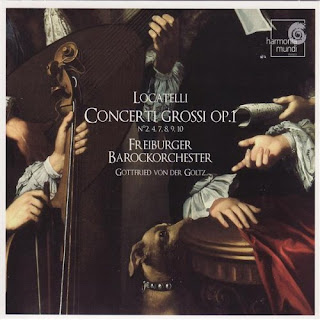
Locatelli - Concerti Grossi Op.1 - Freiburger Barockorchester, Goltz


Locatelli - Concerti Grossi Op.1 - Freiburger Barockorchester, Goltz
Concerto | Eac, Ape, cue | log, cover | 1 CD, 308 MB
November 14, 2006 | Harmonia Mundi | RapidShare


There is absolutely nothing here to criticize. The Freiburg Baroque Orchestra is one of the premier ensembles of its type, and it performs this music on top form. Locatelli's Op. 1 is nicely varied as to content, particularly in this selection. Only one concerto (No. 7) follows Vivaldi's three-movement "Venetian" form; the remainder are modeled on Corelli's concerti grossi and have four or five movements apiece. Locatelli's "sarabandas" are particularly lovely, and they are enhanced by the characterfully varied treatment of the continuo throughout these performances. Concerto No. 8 is a "pastoral", as in Corelli's famous Christmas Concerto, while four of the six works featured here employ minor keys, which only heightens the music's expressive intensity. In short, you won't find a better-chosen, more appealing selection of high Baroque concertos anywhere, and the engineering is typically splendid. For fans of the period, this is self-recommending. [4/5/2007] --David Hurwitz

CD Content

Concerto XI a quattro en ut mineur
Concerto VIII "Pastorale" A Cinque En Fa Mineur
Concerto VII a cinque en Fa majeur
Concerto II a quattro en ut mineur
Concerto IX a quattro en Ré majeur
Concerto IV a quattro en mi mineur

Performed by:

Gottfried von der Goltz (Conductor)
Freiburg Baroque Orchestra (Orchestra)

LinkWithin

Related Posts with Thumbnails