Showing posts with label Purcell Quartet. Show all posts

Monday, November 30, 2009

Moroney, Davitt (harpsichord) - The Purcell Manuscript


Moroney, Davitt (harpsichord) - The Purcell Manuscript
Harpsichord | Eac, flac, cue | no log, cover | 1 CD, 410 MB
March 6, 2001 | EMI | RapidShare


The British Library have acquired a unique autograph manuscript of keyboard music, including pieces by Henry Purcell, written in his own hand, five of them previously unknown. The manuscript came to light when it was put up for auction at Sotheby's in May 1994. (It is the only surviving Purcell autograph in its original binding.)

An export license was denied the purchaser to enable a national institution to equal the price of £287,000 (this is the first time an export license for a musical manuscript has been withheld on the grounds of national importance). This sum was achieved by donations from a variety of sources including £106,500 from the National Heritage Memorial Fund and £50,000 from EMI Records UK and Thorn EMI plc. The harpsichordist Davitt Moroney was allowed to record the pieces—which include works by Giovanni Battista Draghi—and the disc has been released by Virgin Classics.


CD Content


Suite for harpsichord No. 4 in A minor (from "A Choice Collection of Lessons"), Z. 663
Composed by Henry Purcell

Prelude for keyboard (discoverd in 1993)
Composed by Henry Purcell

Minuet for keyboard (discoverd in 1993)
Composed by Henry Purcell

Air for keyboard (discoverd in 1993)
Composed by Henry Purcell

Thus Happy and Free (from "The Fairy Queen), prelude, soprano aria & chorus, Z. 629/44
Composed by Henry Purcell

The Double Dealer, incidental music, Z. 592 No. 9, Air
Composed by Henry Purcell

The Double Dealer, incidental music, Z. 592 No. 7, Minuet
Composed by Henry Purcell

The Virtuous Wife, or, Good Luck at Last, incidental music, Z. 611 No. 8, Trumpet Minuet
Composed by Henry Purcell

The Virtuous Wife, or, Good Luck at Last, incidental music, Z. 611 No. 7, Minuet
Composed by Henry Purcell

The Fairy Queen, semi-opera, Z. 629 No. 1b, Hornpipe
Composed by Henry Purcell

The Virtuous Wife, or, Good Luck at Last, incidental music, Z. 611 No. 9, Air
Composed by Henry Purcell

The Old Bachelor, incidental music, Z. 607 No. 4, Hornpipe (unique transcription, discovered 1993)
Composed by Henry Purcell

Hornpipe for keyboard (discovered in 1993, previously attrib. to John Eccles)
Composed by Henry Purcell

Suite for harpsichord (from "The Second Part of Musick's Handmaid") in C major, Z. 665 Prelude
Composed by Henry Purcell

Suite for harpsichord (from "The Second Part of Musick's Handmaid") in C major, Z. 665 Almand
Composed by Henry Purcell

Suite for harpsichord No. 5 in C major (from "A Choice Collection of Lessons"), Z. 666 Corant
Composed by Henry Purcell

Suite for harpsichord No. 5 in C major (from "A Choice Collection of Lessons"), Z. 666 Sarraband
Composed by Henry Purcell

The Queen's Command, for keyboard, MB28
Composed by Orlando Gibbons

Suite for harpsichord in A major
Composed by Giovanni Battista Draghi
with Davitt Moroney

Suite for harpsichord in G minor
Composed by Giovanni Battista Draghi

Suite for harpsichord in C minor
Composed by Giovanni Battista Draghi

Suite for harpsichord in G major
Composed by Giovanni Battista Draghi


Tuesday, September 22, 2009

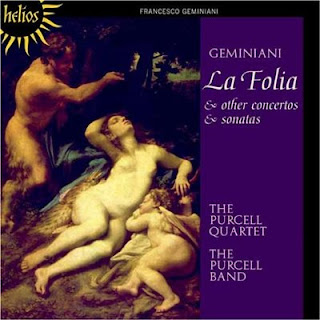
Geminiani - La Folia - The Purcell Quartet


Geminiani - La Folia - The Purcell Quartet
Baroque | Eac, flac, cue | log, cover | 1 CD, 270 MB
August 14, 2007 | Hyperion UK | RapidShare


Over the course of three centuries, more than 150 composers have used the theme of "La Folia" in their works. The first publications of this theme date from the middle of the 17th century, but it is probably much older. Plays of the renaissance theatre in Portugal, including works by Gil Vicente, mention the folia as a dance performed by shepherds or peasants. The Portuguese origin is recorded in the 1577 treatise De musica libri septem by Francisco de Salinas. Examples of early folias include works by Juan del Encina in 1520, Diego Ortiz in 1553, and Antonio de Cabezón in 1557. Jean-Baptiste Lully, in collaboration with Philidor in 1672, Arcangelo Corelli in 1700, Alessandro Scarlatti in 1710, Antonio Vivaldi in his Opus 1 No 12 of 1705 and Johann Sebastian Bach in his Peasants' Cantata of 1742 are considered to highlight this 'later' folia repeating theme in a brilliant way. In the 19th century the theme's popularity decreased, but it regained composers' interest during the 1930s with Sergei Rachmaninov in his Variations on a theme by Corelli in 1931 and Manuel María Ponce and his Variations on "Spanish Folia" and Fugue for guitar.

CD review
This is a reissue – and a welcome one – on Hyperion’s Helios label; it’s a collection of string pieces by the late Baroque composer Francesco Geminiani. First released twenty years ago, it makes a valid and representative introduction to some of the strengths of Geminiani. At the same time the selection highlights the skills and interpretative powers of performers, many of whom were just beginning to make names for themselves in the 1980s and are now firmly established as specialists in their fields. Indeed the Purcell Quartet was in the middle of a wider series of chamber music based on La Folia.

Geminiani’s Concerto Grosso is actually the only work on this disc so based. It’s beautifully played here, though. There is energy, a sailing and uplifting movement in what’s already a lively and extrovert theme. The other Concerto Grosso, the G Minor Opus 7 number 2, is tackled just as stylishly and should convince anyone sceptical of Geminiani’s place in the canon that his blend of thematic thrift and apposite instrumentation admirably vindicates his champions’ faith in the composer’s inventiveness and technical adeptness.

There are three Trio Sonatas here. Number 3 in F Major seems at time to be holding back and has the most delightful, subtle melodies. Number 5 in A Minor has just as much sophistication, variety and emerges through gentle curves and swayings of sound; the opening movement has some exciting yet controlled counterpoint. And number 6 in D Minor has an almost Handelian middle movement and much uplifting yet not unserious ripieno and thrusting passages which reveal the beauty of these dedicated players’ string sound.

The thing you’ll probably notice as you settle into the first few tracks is the sedate pace - a marked slowness of tempi. This is all to the good - for the unrushed unfolding of thematic ideas and supporting instrumentation allow the music to breathe, and every nuance to be fully audible. Indeed there is a dignity and gravitas to, for example, the F Major’s gentle statement and counter-statement; they make it sound more classical than spontaneous. Yet the execution here is far from predictable or dull. Similarly the gentle, walking pace with which each of the players sets out the theme of La Folia itself has the effect, almost, of a first time hearing. Most welcome.

Elizabeth Wallfisch hits some high spots and sends shivers down the spine with her performance of the Opus 1 number 3 solo sonata in E Minor; Catherine Mackintosh similarly does opus 4 number 12 proud – though with perhaps not quite the same self-confidence as Wallfisch.

So there’s a pleasing array of textures, musical ideas and harmonic depth on this CD. It bears repeating that this is music originally meant for amateur, ‘local’ performance (and consumption). Its flavour has been suavely picked up and handled very well by these consummate professionals. The lasting impression remains of unspectacular detachment; the music is played with a generous seriousness that nevertheless never cloys nor draws attention to itself. It’s stately and almost regal at times. Maybe that’s chiefly because tempi are a tiny bit slower than we have become used to in intervening years. But really none the worse for that – we can savour every turn and phrase.

The fact that these dozen accomplished musicians haven’t thereby rendered the music in any way ‘precious’ must originate in their evident exuberance, and enjoyment of knowing and presenting it. There’s a genuineness and gentle familiarity in their playing that makes them superb ambassadors for what Geminiani was aiming at – and what he usually so successfully achieved: persuasive, thoughtful and accessible music of great originality and subtle beauty.


The Purcell Quartet

Geminiani (who studied with Corelli in Rome) seems to have been a bit… ‘needy’ where conducting and organizing his own music was concerned; Burney put his failings down to a shaky sense of tempi! He was more adept at re-arranging (his) music when necessary – indeed it is the 1739 revision of his Opus 1 from 1716 that we hear on this CD. The musicians here play with never a hint of such shortcomings thereby lifting the music into a more refined, almost rarefied, sphere. But, again, this steadiness is a big plus where music of such delicacy is concerned.

The liner notes are somewhat on the sparse side; the sound is more than adequate if a little closely recorded, and the quantity not all that generous at little more than 50 minutes. All in all this is a disc that can be thoroughly recommended. Listening to it carefully and with renewed attention (there’s always something new at each hearing… a delayed harpsichord entry, an apposite rallentando, a striking counterplay of closing chords) will bring hours of pleasure.--Mark Sealey


Tracks:
01 - Purcell Quartet - Geminiani: Trio Sonata #3 in F, Op. 1/9 - 1. Largo (03:16)
02 - Purcell Quartet - Geminiani: Trio Sonata #3 in F, Op. 1/9 - 2. Andante (02:12)
03 - Purcell Quartet - Geminiani: Trio Sonata #3 in F, Op. 1/9 - 3. Allegro (03:23)
04 - Purcell Quartet - Geminiani: Concerto Grosso "La Folia" (10:53)
05 - Purcell Quartet - Geminiani: Sonata in E minor, Op. 1/3 - 1. Adagio - Allegro - Adagio (01:36)
06 - Purcell Quartet - Geminiani: Sonata in E minor, Op. 1/3 - 2. Tempo giusto - Adagio (01:32)
07 - Purcell Quartet - Geminiani: Sonata in E minor, Op. 1/3 - 3. Allegro (02:44)
08 - Purcell Quartet - Geminiani: Trio Sonata #5 in A minor, Op. 1/11 - 1. Spiritoso (01:40)
09 - Purcell Quartet - Geminiani: Trio Sonata #5 in A minor, Op. 1/11 - 2. Andante (02:05)
10 - Purcell Quartet - Geminiani: Trio Sonata #5 in A minor, Op. 1/11 - 3. Allegro (02:27)
11 - Purcell Quartet - Geminiani: Trio Sonata #6 in D minor, Op. 1/12 - 1. Andante (02:02)
12 - Purcell Quartet - Geminiani: Trio Sonata #6 in D minor, Op. 1/12 - 2. Allegro (02:09)
13 - Purcell Quartet - Geminiani: Trio Sonata #6 in D minor, Op. 1/12 - 3. Allegro (02:05)
14 - Purcell Quartet - Geminiani: Sonata in A major, Op. 4/12 - 1. Adagio - Presto (01:53)
15 - Purcell Quartet - Geminiani: Sonata in A major, Op. 4/12 - 2. Presto (01:38)
16 - Purcell Quartet - Geminiani: Sonata in A major, Op. 4/12 - 3. Presto (01:20)
17 - Purcell Quartet - Geminiani: Concerto Grosso in G minor, Op. 7/2 - 1. Grave - Allegro (04:16)
18 - Purcell Quartet - Geminiani: Concerto Grosso in G minor, Op. 7/2 - 2. Andante (01:24)
19 - Purcell Quartet - Geminiani: Concerto Grosso in G minor, Op. 7/2 - 3. Allegro (03:04)


Monday, August 31, 2009

Biber - Harmonia artificiosa-ariosa - The Purcell Quartet


Biber - Harmonia artificiosa-ariosa - The Purcell Quartet
Baroque | Eac, flac, cue | log, cover | 2 CD, 421 MB
September 20, 1994 | Chandos | RapidShare


The Purcell Quartet has become recognized as one of the leading chamber groups in the realm of Baroque music performance. As its name suggests, the group has devoted much effort to championing the chamber works of Henry Purcell, playing and recording whole chunks of his output: the complete three- and four-part sonatas and complete pavans. But the group's vast repertory also includes works by J.S. Bach, Corelli, Handel, Vivaldi, Schütz, and many other Baroque composers. In addition -- and what makes the Purcell players unique -- they have staged operas, such as Monteverdi's L'Incoronazione di Poppea and have presented large choral works in concert by Bach, including cantatas and masses. They have also made over 40 recordings, mostly for the Chandos label.

The Purcell Quartet was founded in London in 1983, but did not give its debut concert until February 14, the following year, at London's St. John's, Smith Square. The group's members then were Robert Woolley (keyboard), Catherine Mackintosh (violin), Elizabeth Wallfisch (second violin), and Richard Boothby (cello; viola da gamba). Only one change in personnel has taken place over the years: violinist Catherine Weiss replaced Wallfisch.

The group had immediate success following its triumphant 1984 debut concert, and within three years turned out six recordings for the Hyperion label, each devoted to a different Baroque composer: Vivaldi, Corelli, Alessandro Scarlatti, C.P.E. Bach, Geminiani, and Marais. In 1987 the ensemble began recording for Chandos Records and has produced more than 40 CD titles for that British label.

By the early '90s, the Purcell Quartet was in great demand, both at home and abroad. Numerous concert tours took the quartet not only throughout the U.K., but across Europe, the U.S., South America, and parts of the Middle East. In 1998 the group traveled to Japan to stage performances of Monteverdi's L'Incoronazione di Poppea. Three years later it returned for another important tour, this one featuring a highly successful staging of Monteverdi's L'Orfeo starring Mark Padmore. Other leading vocalists have typically appeared at the Purcell Quartet's opera and concert productions over the years, including Emma Kirkby, Nancy Argenta, Michael Chance, and Peter Harvey.

The Purcell Quartet marked its 20th anniversary in an acclaimed February 2004 concert at Wigmore Hall. The ensemble has remained very active in the recording studio, and among its recordings is the 2006 Chandos CD of Couperin's Les Nations, Vol. 2.


Heinrich Ignaz Franz von Biber (12 August 1644 – 3 May 1704)


Heinrich Ignaz Franz von Biber (12 August 1644 – 3 May 1704) was a Bohemian-Austrian composer and violinist. Born in the small Bohemian town of Wartenberg, Biber worked at Graz and Kroměříž before he illegally left his Kroměříž employer and settled in Salzburg. He remained there for the rest of his life, publishing much of his music but apparently seldom, if ever, giving concert tours.

Biber was one of the most important composers for the violin in the history of the instrument. His technique allowed him to easily reach the 6th and 7th positions, employ multiple stops in intricate polyphonic passages, and explore the various possibilities of scordatura tuning. He also wrote one of the earliest known pieces for solo violin, the monumental passacaglia of the Mystery Sonatas. During Biber's lifetime, his music was known and imitated throughout Europe. In late 18th century he was named the best violin composer of the 17th century by music historian Charles Burney. In late 20th century Biber's music, especially the Mystery Sonatas, enjoyed a renaissance. Today, it is widely performed and recorded.


CD 1 Tracks:
01 - Purcell Quartet with Elizabeth Wallfisch - Partita I in D minor - I. Adagio - Presto - Adagio (03:00)
02 - Purcell Quartet with Elizabeth Wallfisch - Partita I in D minor - Ii. Allamande (02:00)
03 - Purcell Quartet with Elizabeth Wallfisch - Partita I in D minor - Iii. Gigue (04:32)
04 - Purcell Quartet with Elizabeth Wallfisch - Partita I in D minor - Iv. Aria (02:10)
05 - Purcell Quartet with Elizabeth Wallfisch - Partita I in D minor - V. Sarabande - (03:11)
06 - Purcell Quartet with Elizabeth Wallfisch - Partita I in D minor - Vi. Finale. Presto (00:42)
07 - Purcell Quartet with Elizabeth Wallfisch - Partita II in B minor - I. Praeludium (02:09)
08 - Purcell Quartet with Elizabeth Wallfisch - Partita II in B minor - Ii. Allamande - (02:58)
09 - Purcell Quartet with Elizabeth Wallfisch - Partita II in B minor - Iii. Balletto. Allegro (01:03)
10 - Purcell Quartet with Elizabeth Wallfisch - Partita II in B minor - Iv. Aria. Presto (00:46)
11 - Purcell Quartet with Elizabeth Wallfisch - Partita II in B minor - V. Gigue. Presto (01:43)
12 - Purcell Quartet with Elizabeth Wallfisch - Partita III in A major - I. Praeludium. Allegro (01:32)
13 - Purcell Quartet with Elizabeth Wallfisch - Partita III in A major - Ii. Allamande (01:51)
14 - Purcell Quartet with Elizabeth Wallfisch - Partita III in A major - Iii. Amener. Presto (01:05)
15 - Purcell Quartet with Elizabeth Wallfisch - Partita III in A major - Iv. Balletto (00:55)
16 - Purcell Quartet with Elizabeth Wallfisch - Partita III in A major - V. Gigue (00:40)
17 - Purcell Quartet with Elizabeth Wallfisch - Partita III in A major - Vi. Ciacona. Canon In Unisono (04:14)
18 - Purcell Quartet with Elizabeth Wallfisch - Partita IV in E flat major - I. Adagio - Allegro - Adagio (02:40)
19 - Purcell Quartet with Elizabeth Wallfisch - Partita IV in E flat major - Ii. Allamande (01:32)
20 - Purcell Quartet with Elizabeth Wallfisch - Partita IV in E flat major - Iii. Trezza. Presto (00:53)
21 - Purcell Quartet with Elizabeth Wallfisch - Partita IV in E flat major - Iv. Aria (01:17)
22 - Purcell Quartet with Elizabeth Wallfisch - Partita IV in E flat major - V. Canaria (00:36)
23 - Purcell Quartet with Elizabeth Wallfisch - Partita IV in E flat major - Vi. Gigue. Presto (01:18)
24 - Purcell Quartet with Elizabeth Wallfisch - Partita IV in E flat major - Vii. Polcinello. Presto (00:22)


CD 2 Tracks:
01 - Purcell Quartet with Elizabeth Wallfisch - Partita V in G minor - I. Intrada. Alla Breve (01:32)
02 - Purcell Quartet with Elizabeth Wallfisch - IPartita V in G minor - i. Aria. Adagio (01:31)
03 - Purcell Quartet with Elizabeth Wallfisch - Partita V in G minor - Iii. Balletto. Presto (00:34)
04 - Purcell Quartet with Elizabeth Wallfisch - Partita V in G minor - Iv. Gigue (00:58)
05 - Purcell Quartet with Elizabeth Wallfisch - Partita V in G minor - V. Passacaglia (05:32)
06 - Purcell Quartet with Elizabeth Wallfisch - Partita VI in D major - I. Praeludium. Adagio - Allegro (02:54)
07 - Purcell Quartet with Elizabeth Wallfisch - Partita VI in D major - Ii. Aria Con Variatio (13:28)
08 - Purcell Quartet with Elizabeth Wallfisch - Partita VI in D major - Iii. Finale. Adagio - Allegro (01:23)
09 - Purcell Quartet with Elizabeth Wallfisch - Partita VII in C minor - I. Praeludium. Grave - Presto (03:03)
10 - Purcell Quartet with Elizabeth Wallfisch - Partita VII in C minor - Ii. Allamande (01:50)
11 - Purcell Quartet with Elizabeth Wallfisch - Partita VII in C minor - Iii. Sarabande (01:55)
12 - Purcell Quartet with Elizabeth Wallfisch - Partita VII in C minor - Iv. Gigue. Presto (02:22)
13 - Purcell Quartet with Elizabeth Wallfisch - Partita VII in C minor - V. Aria (01:56)
14 - Purcell Quartet with Elizabeth Wallfisch - Partita VII in C minor - Vi. Trezza (00:46)
15 - Purcell Quartet with Elizabeth Wallfisch - Partita VII in C minor - Vii. Arietta (07:19)


LinkWithin

Related Posts with Thumbnails