Showing posts with label Vivaldi. Show all posts

Saturday, June 11, 2011

Vivaldi - Concerti per il flauto traversier – Alexis Kossenko, Arte Dei Suonatori


Review:

This is an absolutely splendid release and a must-have for all Vivaldi lovers as well as for all who appreciate vibrant playing in truly historically informed performances. French-born flutist Alexis Kossenko is an award-winning artist who devotes his talent more or less equally to both the modern and Baroque flute. In the former capacity, he has performed under the direction of Mstislav Rostropovitch and Valery Gergiev and recorded the Nielsen flute concerto with Justus Frantz and the Philharmonie der Nationen. In the latter capacity, he has partneredAlexis Kossenko Baroque specialists such as Richard Egarr, Andrew Manze, and Catherine Bott, and has performed under John Eliot Gardiner, Philippe Herreweghe, Skip Sempé, Jean-Claude Malgoire, Jos van Immerseel, Jaap ter Linden, and Fabio Biondi.

This is not my first encounter with Kossenko and the Polish Arte Dei Suonatori ensemble. Kossenko’s playing of flute concertos by C. P. E. Bach are simply astonishing and a must-buy. If icing on the cake be needed, it comes in the form of a thick French and English booklet containing notes on each individual concerto, detailed information on the instruments employed, and several pages of high-quality photographs. Viva Vivaldi, and kudos to Kossenko, Arte Dei Suonatori, and Alpha for a beautiful recording. 


flac, booklet thank you Thomas!

Friday, May 27, 2011

Tafelmusik Baroque Orchestra - A Baroque Feast


Review:

Even people who don't normally listen to classical music seem to love the singable melodies and effervescent rhythms that characterize much of the Baroque orchestral repertoire. Certain works have become favorites of television commercial and film producers, and chamber orchestras everywhere endlessly program selections from Handel's Water Music, Bach's Brandenburg Concertos, Vivaldi's Four Seasons, Albinoni's Adagio, and various works by Purcell, Locatelli, and Marcello--along with that dreadful and highly overrated "canon" by that guy whose name begins with "P". Most of these composers (thankfully not Pachelbel) are Tafelmusik Baroque Orchestra represented here, on this perfectly fine if just a little too-familiar program that features Handel's Arrival of the Queen of Sheba, Purcell's Suite from Abdelazar, and Vivaldi's A minor concerto for two violins Op. 3 No. 8. To the producers' credit, the disc also includes some less-commonly-heard selections such as Handel's lovely Concerto for harp in B-flat major and Marcello's Oboe concerto in D minor. We're also treated to the richly scored, melodically engaging Op. 1 No. 8 Concerto grosso in F minor by Locatelli and to a lovely Sinfonia by Bach (from his Cantata No. 42). Overall, the program has a musical coherence and a pleasing sonic quality that encourages easy and pleasant listening.

Of course, the Toronto-based Tafelmusik, one of North America's two or three top-rank period-style orchestras, delivers these Baroque staples with interpretive authority and impressive yet thankfully unadorned technique, giving careful attention to line in the slow movements and keeping rhythms and articulation crisp in the fast ones. The solo playing is first-rate (particularly the harp and oboe), and the sound gives desirable presence and clarity to the varied instrumental configurations. If you're looking for a very well-played, intelligently programmed recording of attractive Baroque orchestral music, look no further.--David Vernier


flac, scans

Thursday, May 26, 2011

Il Gardellino - Concerti d'Amore - Telemann, Vivaldi, Graupner


Review:

Marcel Ponseele is generally considered one of the foremost Baroque oboists of his time: conductor Philippe Herreweghe has called him the finest Baroque oboist in the world. Ponseele is also a conductor of international renown. Like many talented instrumentalists from the latter half of the 20th century, he often conducts while performing as soloist in concert. He has made numerous recordings with Il Gardellino in these dual roles, particularly in the music of J.S. Bach. Ponseele's repertoire Marcel Ponseeleextends not only to other Baroque icons, like Antonio Vivaldi, Georg  Frideric Handel, and Georg Philipp Telemann, but to lesser known figures like Johann Gottlieb Graun, Christoph Schaffrath, Ernst Eichner, and many others.
Marcel Ponseele is internationally known as Baroque specialist, and is often invited as a soloist to perform with great orchestra's or to participate on different recordings. Together with Jan De Winne and Shalev Ad-El, he founded in 1988 the Baroque ensemble Il Gardellino, of which he's the artistic leader. Over the years he has become strongly identified with the group.


flac, covers

Saturday, May 14, 2011

Ariosti - The Flowering and Fading of Love (Cantatas) - Musica Solare


Review:

Attilio Ariosti, an Italian composer of the generation of Alessandro Scarlatti, was born in Bologna, and ordained as a priest. His first compositions were oratorios, but after composing his first opera in 1697 he concentrated on writing music for the theatre. A year before he had entered the service of the Duke of Mantua, who sent him to Berlin to the court of Sophie Charlotte, Electress of Brandenburg. He was appointed 'maître de musique' and became Sophie Charlotte's favourite musician. Later on he worked at the imperial court in Vienna, where he was held in high esteem by Joseph I. He worked as one of Joseph I’s diplomats in Italy, and after Joseph's death entered the service of theAttilio Ariosti Duke of Anjou, the future French king Louis XV. His output is rather limited in comparison to that of some of his more famous contemporaries. This is almost certainly down to his many activities as a diplomat, but also as a music teacher and an interpreter; he was a singer and played the keyboard, the cello and the viola d'amore. Darja Großheide writes: "The present cantatas form a sonnet sequence, ranging from 'La Rosa' (The Rose) to 'Il Naufragio' (The Shipwreck) and the final 'La Gelosia' (Jealousy). This has suggested the title 'The Flowering and Fading of Love'". She doesn't give any evidence that Ariosti himself presented these cantatas as a cycle. And at first sight it seems that some of the sonnets have nothing to do with love. But there are several reasons to support Ms Großheide's view. These are very nice cantatas, and the performers fully explore their expressive qualities. The soprano and contralto have beautiful voices, which are very pleasant to listen to, and vividly communicate the feelings of the protagonist. The recitatives are sung with some rhythmic freedom, but the singers could have taken more liberties in this respect. The instrumentalists give fine performances, showing great sensitivity for the way Ariosti has illustrated the text in his music.


flac, scans

Wednesday, April 13, 2011

Vivaldi - 5 Bassoon Concertos - Milan Turkovic, I Solisti Italiani


Review:

Milan Turković (born 1939) is an Austrian bassoonist who was born in Zagreb, Croatia but grew up in Vienna, Austria. He is considered one of the few internationally known soloists on his instrument. He was for many years the principal bassoon of the Vienna Symphony as well as a member of the period instrument ensemble Concentus Musicus Wien. Turković is a member of the Ensemble Wien-Berlin, a woodwind quintet consisting of principal players of the Berlin and Vienna Philharmonic orchestras, and the Chamber Music Society of Lincoln Center of New York.Milan Turkovic

From 1984 until 1992, Turković was professor of bassoon at the Salzburg Mozarteum. From 1992 until 2003, he taught at the Musikhochschule (conservatory) in Vienna. Since then he has concentrated increasingly on conducting.

Turković has performed as soloist with many important orchestras around the world, including the Vienna Symphony, Stockholm Philharmonic, Bamberg Symphony, Munich Philharmonic, Orchestre de la Suisse Romande, Stuttgart Chamber Orchestra, St. Louis Symphony, Chicago Symphony Orchestra, English Concert, I Solisti Italiani, Camerata Academica Salzburg, NHK Symphony Tokyo, under conductors such as Christoph Eschenbach, Carlo Maria Giulini, Nikolaus Harnoncourt, Sir Neville Marriner, Christopher Hogwood, Trevor Pinnock, Wolfgang Sawallisch, Horst Stein, Sandor Vegh, David Zinman, among others.

His discography consists of 15 CDs of solo repertoire, 26 CDs of chamber music, and over 200 CDs as a member of Concentus Musicus. He has recorded the Mozart Bassoon Concerto four times, the third having been played on a period instrument, Nikolaus Harnoncourt conducting. Turkovic's most recent releases include concerti of Weber with Marriner, five bassoon concerti by Vivaldi with I Solisti Italiani, and concerti of Christian Bach and Kozeluh.


flac, scans

Wednesday, March 30, 2011

Vivaldi - Variations on 'La Folia' and other Sonatas - The Purcell Quartet


Review:

Lush and sensuous, the Purcell Quartet's 1985 recording of sonatas and trio sonatas by Vivaldi belies both the purity of period instruments and the chastity of the music. Violinists Catherine Mackintosh and Elizabeth Wallfisch, cellist Richard Boothby, and harpsichordist Robert Woolley use intonation not portemento to create nuances, phrasing not tempo rubato to control pulse, and swells not vibrato to achieve climaxes. Under their hands and bows, Vivaldi's chamber music sounds much more passionateAntonio Vivaldi and intimate than usual, quite unlike the work of a retiring asthmatic priest and much more like the work of an emotional Italian of the eighteenth century. Any movement -- the ardent Allegro assai in the G minor Trio Sonata, the soulful Sarabande from the C major Sonata -- proves the point, but start with the title track: the single-movement D minor Trio Sonata is a nearly 10-minute set of variations on the old Spanish La Folia song. Listen to how Mackintosh and Wallfisch blend and weave, how Woolley adds embellishments and continuo, how Boothby backs them up and nails them down, how together they bind and unite the variations in a seamless chain of emotional intensity and musical concentration. Hyperion's early digital sound is warmer and deeper than its later digital sound.

flac, booklet

Saturday, March 26, 2011

Vivaldi - The Four Seasons and other Concertos - Amandine Beyer, Gli Incogniti


Review:

Amandine Beyer, who won the 2001 Vivaldi international competition in Turin, has released her superb recording of Vivaldi's Four Seasons. This is truly a performance that blows any cobwebs from the popular piece, and includes premiere recordings of newly reconstructed Vivaldi concertos.

"Majestic, gossamer, hypnotic. Perfect in every inflection of the phrasing, which the young soloist sculpts with a sense of space, magnificently served by the recorded sound." -- Le Monde

Amandine Beyer What makes this recording special? The first factor is the orchestra. It is 'one to a part', which is to say, one solo violin, one first violin, one second violin one viola, one cello, one bass plus continuo (usually harpsichord and theorbe). The liner notes argue convincingly that Vivaldi probably composed the Seasons for an orchestra of virtuosi none bigger than this. But, if you aren't convinced by historical conjecture, the sound of 'one to a part' will convince you. The rustic and expressive elements make this small orchestra ideal for the subject matter. For example, Carmignola's Sony recording of the Seasons is one of the best I've heard but there are a few problems. The interpretation is too polite and not rustic enough and the orchestra is too light in the bass and thin sounding. This recording improves on these elements. Amandine Beyer is fantastic as the soloist. She is a disciple of Carmignola and while her amazing virtuosic gift may not be quite as slick, her more rustic, natural playing is certainly on par with Vivaldi's music. Perhaps an overlooked aspect of the Seasons is the orchestra writing. The main failing of the Carmignola recording was on the orchestra side and the engineering of the recording. Here, Gli Incogniti is every bit as dynamic as the soloist--just as Vivaldi intended 


flac, scans

Wednesday, March 9, 2011

Vivaldi - Concerti Per Viola d'Amore - Biondi, Europa Galante


Review:


Like all good Baroque composers, Vivaldi was a superb performer: records exist of audiences literally fighting to hear him play. One of Vivaldi’s favourite instruments was the viola d’amore, a twelve-stringed invention of the mid-seventeenth century. Typically, six or seven gut strings were played; the lowest three usually wound. Then there was the same number under the unfretted fingerboard; they acted as resonators. Viola d'amoreThe instrument was often tuned to the principal notes of the tonic chord. This fact – and its rather ‘nasal’ resonance - gave the viola d’amore a particularly sweet and soft sound – especially when compared with that of the voila itself. Played on the arm, the viola d’amore was almost the clavichord to the viola’s harpsichord, if you like.

So, the eight concerti on this welcome CD from Fabio Biondi and Europa Galante have a gentle and supple quality which sits interestingly with Vivaldi’s driven and extrovert concerto style. Biondi takes the viola d’amore lead and plays with great aplomb and vigour. The instrument has sinuous, at times almost ‘gypsy’ fruitiness - as in the largo of RV 395, for example. The temptation is to emphasise this at the expense of the writing’s subtleties and nuances. This is a temptation which Biondi effortlessly avoids: the allegro of RV 396 is a good example of his subtler approach. The exposition is unself-conscious and the pace at which Vivaldi’s ideas are presented and developed neither obscures nor gives undue weight to the consonance between solo instrument and supporting players; but see below, theirs is no conventional continuo role.

This is all to the good: Vivaldi’s own relationship with the viola d’amore was a special one. He did not consider it exotic, antique or a curiosity. Rather, he insisted on teaching it to some of his ablest pupils at a time when it was losing favour in the wider world. Biondi and his forces have managed to reflect very well the status of the viola d’amore for Vivaldi. The feeling of their playing is midway between ‘every day’ and of a quiet pride in its recherché nature by the unassuming specialist.

In fact this disc contains all of Vivaldi’s output for the instrument except for four arias with viola d’amore obbligato. RV 392 displays the twin characteristics of festivity and reserve: the soloist helps to steer a careful balance between the two moods; and does so with that apparent spontaneity which Vivaldi achieved so well. RV 393 is more austere with much dotted rhythm. It is full of drama – which means it is full of contrasts. RV 394 also draws on dance - folk dance; the ornamentation is a virtuoso’s delight. RV 395 uses court dances; greater use is made of counterpoint and more subtle rhythms. RV 396 is more complex still and seems to offer yet greater opportunities for virtuosic display; its slow movement is in sonata form. RV 397 is one of Vivaldi’s dour and dolente works. The sorrow somehow comes from within the music; it’s not forced, thanks to the cantabile nature of the writing. On hearing the insistent ritornelli at the beginning and end of this concerto, is it too fanciful to associate such unhappiness with a certain anger on Vivaldi’s part? Again, it’s to Biondi’s credit that such expressive, emotive playing never swamps the music’s meaning. It is tuneful, clear of texture and shot through with steady tempi without losing bite for a second.

One should not be put off by this scope for virtuosity; or refrain from approaching the music as music. Repeated hearings of this generous CD will leave you inspired by the variety, the understatement and the creative integrity with which Vivaldi approached his task. This was a task which looked forward to the more figurative style of the end of the eighteenth century. One resource that Vivaldi used to achieve this was to have his soloists play in concertante style. They all perform the ritornelli as well as the solo passages. There is thus less a sense of accompaniment; more of a symphonic whole. RV 97 with horns and staccato rhythms shows this nicely: full-scale drama making its impact with orchestral tone as much as with melody and harmony.

The double concerto for viola d’amore and lute, RV 540, was written later than the other concerti here; indeed it was written at the very end of Vivaldi’s life. It seems to hint at valediction and betrays perhaps tender regrets with a wisp of nostalgia. Beautifully played here, its misty understatement somehow draws us all the way into Vivaldi’s world and the unfocused introversion of Venice.

So the music on this well-conceived and welcome CD is not an oddity and should not be considered such. The playing is ‘personal’; it approaches the intricacies required by the music appropriately and yet acts as a quiet advocate for this special area of Vivaldi’s concerto writing. The liner-notes are adequate and the recording neither boxed nor sonorous.-- Mark Sealey


flac, covers

Sunday, February 20, 2011

Tafelmusik Baroque Orchestra - Gloria in excelsis Deo


Review:

In a veritable sea of indistinguishable, carbon-copy Baroque orchestras and choruses, Tafelmusik has distinguished itself for nearly 30 years as head and shoulders above most of its competitors. This CD is an excellent example of why. From the very first notes of Bach’s Cantata No. 191, rarely performed in this configuration because all three movements wereTafelmusik Baroque Orchestra later reworked for the far more popular Mass in B Minor, to the concluding notes of Vivaldi’s Gloria, there is not a false step, an uninteresting phrase, a less-than-involved reading of these scores.

Many other early-music groups sing and play with energy. So do the Tafelmusik performers; but they also sing and play with well-bound phrasing, outstanding legato, an extremely well-judged sense of rubato in the correct meaning of the term (too many performers, particularly from 40 years or more ago, misunderstood slow-downs as rubato, when in fact the term means “to steal,” which means that for every Luftpause there must be a corresponding abbreviation in one of the notes following). Listeners who know the Mass well will readily hear what they do in this Cantata.

The music of Jean-Joseph Cassanéa de Mondonville, completely unknown to me, has a certain sense of the type of religious-occasion music that I normally dislike, but again Tafelmusik’s performance breathes such fresh life into this ancient score that it catches one up in its rare enthusiasm. Listen, for just one detail, to the way the chorus separates the staccato notes on the phrase “et pra-e-cinx-it-se!” Without overdoing the stress accents one bit, they create tremendous musical tension. That is the mark of great musicians, regardless of era, style, or chosen instrument or group size. In the following trio, “Es enim firmavit,” guest tenor Colin Ainsworth joins two singers from the choir, countertenor Robert Kinar and bass Andrew Mahon. Folks, listen to this! They sound for all the world like a trio from the old New York Pro Musica, and their blend is flawless. In the ensuing “Parate sedes,” featured soprano Ann Monoyios is joined by another chorister, soprano Michele DeBoer. Again, the blend is perfect. This is how you sing Baroque vocal ensembles.

The ominous undercurrent of drama that the lower strings create at the beginning of “Elevaverunt flumina” must be heard to be believed; the women in the chorus, when they enter, sing snakelike 16th notes with incredible fluidity of rhythm. Monoyios’s soprano solo in “Testimonia tua” reveals more surprises: this is a singer with feeling, not just another cold, technically perfect soprano. She is a consistent delight to the ear and heart. Even in the stately opening of the final chorus of this motet, Tafelmusik does not let us down, and when the Allegro section enters, we are lifted rhythmically and in mood without being sledge hammered by clipped staccato piping.

Their musical excellence is continued still further in Vivaldi’s Gloria, the more familiar RV 589 as opposed to the less-well-known RV 588 (also in D). Rather than overwhelm the listener with ferocity of rhythm, as so many (one might say, too many) modern Vivaldi performers do, Tafelmusik emphasizes the legato of the vocal line, allowing the clipped rhythms of the accompanying orchestra to buoy the music along naturally rather than aggressively. It is a virtuoso turn.

This CD, as a unified concert, holds up remarkably well against all its competitors. Recorded in a beautifully vibrant-sounding recital hall that sounds for all the world like the nave of a church, the Sonics are simultaneous spacious and detailed. For those who think I’m an old crab when it comes to historically informed performances, I’ll say it again: this is how one should sing and play this music.FANFARE: Lynn René Bayley


flac, covers

Saturday, December 4, 2010

Akademie fur Alte Musik Berlin - Rebel-Elements, Vivaldi-4 Seasons


Review:

This new disc follows on from the stage production in which the orchestra joined forces with a dancer (available on DVD HMD 9909026). Encouraged by the outstanding success of these performances, violinist Midori Seiler and the Akademie für Alte Musik Berlin were keen to re-record the works in the studio. Although free from all choreographic intentions, their interpretation was still profoundly influenced by the experience. This is the first time the group has recorded Vivaldi’s Four Seasons, and a rare appearance for the evergreen work on the harmonia mundi label. 


flac, scans

Saturday, November 20, 2010

Vivaldi - The Four Seasons, Violin Concertos - Holloway, Toso


Review:

I am a huge fan of the Sony Essential Classics budget series. Most of the recordings feature classic and often definitive performances featuring theA portrait of Antonio Vivaldi in 1725 likes of Eugene Ormandy, George Szell, Isaac Stern and Rudolf Serkin among others. Here we get violinist John Holloway with conductor Jean-Claude Malgoire and La Grande Ecurie et la Chambre du Roy performing  Vivaldi's Four Seasons. (The disc concludes with violinist Piero Toso, conductor Claudio Scimone and I Solisti Veneti performing two other popular Vivaldi concertos.) This is an excellent performance of what are arguably the most popular Concertos ever written. My only reservation about this performance is that the pacing on this recording is particularly slow.


ape, cover

Tuesday, September 28, 2010

Fantasie Barocche (Baroque Fantasies) - Hertel, Krebs, Bach, Handel, Vivaldi - Zoboli, Fasolis


Review:


This recording offers a richly varied program of Baroque music with a particularly rewarding assortment of composers and works. Very 'Mediterranean' is the interpretation by Omar Zoboli and Diego Fasolis, who are documenting ten years of friendship and musical partnership through this recording. Original works and transcriptions alternate without any stylistic break and, although playing on modern instruments, the artists respect the principles of early-music performance practice. Here is a CD that places imagination and instrumental mastery at the service of superb music.


ape, scans

Wednesday, September 8, 2010

Encore! - Les Violons du Roy – Labadie


The chamber orchestra Les Violons du Roy borrows its name from the renowned string orchestra of the court of the French kings. The group, which has a core membership of fifteen players, was brought together in 1984 by music director Bernard Labadie and specializes in the vast repertoire of music for chamber orchestra, performed in the stylistic manner most appropriate to each era. Although the ensemble plays on modern instruments, its approach to the works of the Baroque and Classical periods has been strongly influenced by current research into performance practice in the 17th and early 18th centuries; in this repertoire Les Violons du Roy uses copies of period bows. The orchestra has been widely acclaimed for the exceptional energy, brilliance and vitality of its performances.

The eighteen recordings made by Les Violons du Roy have been acclaimed by critics and earned various distinctions and awards at the national and international levels. Of twelve CDs released by DORIAN, two won Juno Awards for classical album of the year.

CD INFO


Ape, scans

Sunday, August 29, 2010

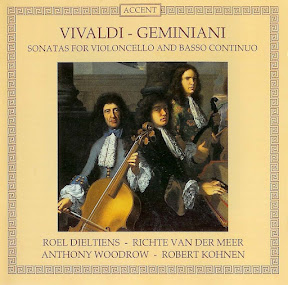
Vivaldi, Geminiani - Cello Sonatas – Dieltiens


It is now generally accepted that Vivaldi wrote ten cello sonatas – one of them now lost. Six (RV 47, 41, 43, 45, 40 and 46) of the surviving nine were published posthumously as a set, in Paris, by Charles-Nicolas Le Clerc around 1740. The other three survive in manuscript collections: RV 42 (along with RV 46) is preserved in the library at Wiesentheid Castle at Unterfranken in Germany; RV 39 and 44 (along with RV 47) are to be found in a manuscript in the Naples Conservatoire.

Antonio VivaldiVivaldi’s sonatas cannot be dated precisely. Without fail they display his profound understanding of the expressive capacities of the instrument. Presumably the lessons he himself learned from his work as teacher of stringed instruments at the Pietà in Venice fed into his writing in these sonatas. All of his nine sonatas are in four movements, disposed slow -fast-slow-fast. In the manuscript of RV 42 the movements carry titles suggesting relationship to particular dances: Preludio-Allemande-Sarabande-Gigue. In the other sonatas the designations are simply of tempos, but the spirit of the dance is never too far away. In his slow movements, Vivaldi’s writing for the cello is often lyrically poignant, but too dignified ever to be merely sentimental.

Geminiani’s opus 5 consists of six cello sonatas, and was first published in Paris in 1746. His sonatas follow the same basic four movement pattern, though some of his slow movements - such as both the adagio and the grave of Sonata no.6 - are so short that the works are less perfectly balanced as regards tempo. All three of the sonatas played here are full of inventive, but unflashy, writing; the best of the slow movements have a tender melancholy and the closing allegros are delightfully vivacious and witty. Roel Dieltiens’ playing has both the drive and the subtlety displayed in his acclaimed recording (also on Accent) of the Bach suites for solo cello. Francesco Geminiani Given that he has worked regularly with masters such as René Jacobs, Frans Brüggen and Philippe Herreweghe his musicianship need come as no surprise. Here he shows himself fully responsive to the demands of the music, in terms of phrasing and intonation, rhythm and ornamentation alike. In the cases of both Vivaldi and Geminiani this is music which both leaves scope for a variety of interpretations and which, in a sense, demands such variety. Given, for example, the decisions that must be made about the instrumentation of the accompaniment – no details being specified in the sources – there is room for a number of interpretative choices, none of which are necessarily ‘wrong’. Here Dieltens eschews the theorbos, archlutes or baroque guitars that some employ. The results are relatively plain in colouring, but none the worse for that.

I wouldn’t want to make a ‘first choice’ in any of this music. Suffice it to say that Dieltens’ performances are ones to which any listener fond of the baroque cello is likely to make frequent returns. The mixing of sonatas by the two composers is suggestive – though I can’t help wishing that Dieltens had given us a complete recording of one the sonatas by one or other of these two Italian masters.—Glyn Pursglove

CD INFO

Ape, scans

Saturday, August 28, 2010

Vivaldi - Complete Cello Sonatas - Gaillard, Pulcinella


The nine surviving cello sonatas by Vivaldi can be presumed to represent only a proportion of the number he probably wrote. I say that knowing that there is room for at least slight doubts as to the authenticity of all of them, especially no.6. Given his clear fondness for the instrument he surely wrote more. After all here was a composer who wrote many cello concertos, There was also the presence of a number of very fine cellists amongst the musicians of the Ospedale della Pièta niot to mention the growing vogue of the instrument in the Venice of his time.


He seems to have taken less trouble to preserve the manuscripts of his sonatas - for whatever solo instrument - than of some of his other music. Though he published two sets of violin sonatas (opp. 2, 5) he chose not to issue any of his sonatas for the cello. The first six to be published appeared in Paris in 1740, in what was surely a pirated edition.


The sonatas we do have very probably date from the 1720s. A few exist in more than one manuscript; none of them autograph. All are in four movements alternating in the sequence slow-fast-slow-fast, a pattern that we associate with the sonata da chiesa. A number of the faster movements are very much informed by the spirit of the dance; in one manuscript, the Wiesentheid, which contains two sonatas, such movements actually carry titles designating the relevant dance rhythms. The slow movements have a winning gravity, in which elegance and a serious quality are held in a beautiful balance.


The young French-Swiss cellist Ophélie Gaillard (b.1974) has already met with considerable success in her recordings of the Bach cello suites (Ambroisie AMB9926) and the Britten Sonatas (Ambroisie AMB9927). This recording of the complete Vivaldi sonatas will surely do her reputation nothing but good. She plays with great beauty of tone, sure-footed musical intelligence and considerable vivacity.


A portrait of Antonio Vivaldi in 1725 Gaillard plays a cello made by Francesco Goffriller at Udine in 1737, an instrument of which she speaks lovingly on the DVD which accompanies the two discs of the sonatas. From it she extracts sounds both brilliant and subtle – which one can appreciate fully on so well recorded a pair of CDs. Gaillard’s conception of the music is perhaps indicated by the very name of the group, Pulcinella, of which she appears to be director and which furnishes the excellent continuo work in this recording. The booklet notes - Gaillard’s own work? - observe of Pulcinella that he was “an emblematic figure of the commedia dell’arte, a delightful bon vivant who originated in Naples and is known in different countries as Punch (short for Punchinello), Polichinelle or Petrushka, also represents the soul of the people. With uncommon vitality and energy and extraordinary adaptability, he always faces up to adversity and is capable of extracting himself from the most difficult situations”. Much of this is communicated in Gaillard’s reading of the music. While these performances are not, in any sense, lacking in refinement, they are what one might call ‘democratic’ interpretations of Vivaldi. These are performances which seek to capture and communicate the rich Venetian atmosphere of the music, the ways in which it articulates what Byron called Venice’s “soft waves, … all musical to song”, praising it as a place where one might encounter “the luxurious and voluptuous flood / Of sweet sensations”. Much of that Venetian spirit is captured in these performances, not only because of Gaillard’s fine playing but also – and perhaps especially – because of the splendidly conceived and variously executed continuo playing of Pulcinella. The range of instruments drawn on for the basso continuo on this recording might, I suppose, have allowed for inappropriate and distracting colour or for mere gimmickry. But there is none of either to be heard here. The balance and dialogue of soloist and continuo are well-nigh perfect throughout and the changes of instrumentation serve primarily to clarify transitions of mood. The use of plucked instruments such as guitar, guitar battente - the instrument strung with wire - and harp, behind/underneath the cello produces some lovely effects.

I have enjoyed this recording greatly. It has a properly Italianate spirit of measured flamboyance and a consistent vision of the music. It is played with acute intelligence – and plenty of feeling – and is beautifully recorded.—Glyn Pursglove

CD INFO

Ape, scans

Thursday, July 22, 2010

Vivaldi - sinfonie d'opera - I Virtuosi Delle Muse, Molardi


The works on this disc span 20 years of Vivaldi's career as an opera composer, from the ouverture of Arsilda (1716) to the sinfonia that opens Griselda (1735). Also included are two of Vivaldi's string sinfonias RV 112 and 137, which the ensemble's director, Stefano Molardi, argues in his scholarly booklet notes were originally the overtures to Orlando finto pazzo and another unknown stage work.

The performances by I Virtuosi delle Muse, directed by Molardi from the harpsichord, are superb. Most notable are the ensemble's rich but subtly graded palette of colours (to accord with Charles de Brosses' enthusiastic observations after hearing Vivaldi and his orchestra in Venice), rhythmic vitality and atmospheric renditions of the slow movements. This last quality is enhanced by the surprising appearance of the viola d'amore among the strings, which Molardi believes often participated in 17th and 18th century Venetian orchestral ensembles.

The resulting harmonic richness is enhanced by the excellent sound quality of the recording.


Tracklist

01. L'Olimpiade, RV 725: Sinfonia: I. Allegro
02. L'Olimpiade, RV 725: Sinfonia: II. Andante
03. L'Olimpiade, RV 725: Sinfonia: III. Allegro moderato
04. L'Olimpiade, RV 725: Sinfonia: IV. Allegro molto
05. L'incoronazione di Dario, RV 719: Sinfonia: I. Allegro
06. L'incoronazione di Dario, RV 719: Sinfonia: II. [Andante]
07. L'incoronazione di Dario, RV 719: Sinfonia: III. Presto
08. Giustino, RV 717: Sinfonia: I. Allegro
09. Giustino, RV 717: Sinfonia: II. Andante
10. Giustino, RV 717: Sinfonia: III. Allegro
11. Concerto for Strings in F major, RV 137: I. Allegro
12. Concerto for Strings in F major, RV 137: II. Andante
13. Concerto for Strings in F major, RV 137: III. Presto
14. Armida al campo d'Egitto, RV 699: Sinfonia: I. Allegro
15. Armida al campo d'Egitto, RV 699: Sinfonia: II. Andante
16. Armida al campo d'Egitto, RV 699: Sinfonia: III. Allegro
17. Arsilda, regina di Ponto, RV 700: Sinfonia: I. Allegro
18. Arsilda, regina di Ponto, RV 700: Sinfonia: II. Andante
19. Arsilda, regina di Ponto, RV 700: Sinfonia: III. Presto
20. La Senna festeggiante, RV 693: Ouverture: Part I: Allegro
21. La Senna festeggiante, RV 693: Ouverture: Part I: Andante molto
22. La Senna festeggiante, RV 693: Ouverture: Part I: Allegro molto
23. La Senna festeggiante, RV 693: Ouverture: Part II: Adagio
24. La Senna festeggiante, RV 693: Ouverture: Part II: Presto
25. La Senna festeggiante, RV 693: Ouverture: Part II: Allegro molto
26. Sinfonia in C major, RV 112: I. Allegro
27. Sinfonia in C major, RV 112: II. Andante
28. Sinfonia in C major, RV 112: III. Presto
29. La fida ninfa, RV 714, Act III: Allegro
30. Griselda, RV 718: Sinfonia: I. Allegro
31. Griselda, RV 718: Sinfonia: II. Andante
32. Griselda, RV 718: Sinfonia: III. Minuet
33. Dorilla in Tempe, RV 709: Sinfonia: I. Allegro
34. Dorilla in Tempe, RV 709: Sinfonia: II. Andante
35. Dorilla in Tempe, RV 709: Sinfonia: III. Allegro


flac

Sunday, January 31, 2010

Vivaldi & Pergolesi - Magnificat, Nisi Dominus - Hogwood, Preston et.al.


Vivaldi & Pergolesi - Magnificat, Nisi Dominus -
Hogwood, Preston et.al.

Sacred | Eac, flac, cue | log, scans | 1 CD, 286 MB
released 1997 | Decca | RapidShare


CD Content
Vivaldi - Nulla in mundo pax sincera - Simon Preston,
Vivaldi - Nisi Dominus - Hogwood,
Vivaldi - Magnificat - Ledger,
Pergolesi - Magnificat - Willcocks.


Wednesday, January 27, 2010

Vivaldi - Cetra Ritrovata - L'Opera Stravagante, Zanenghi


Vivaldi - Cetra Ritrovata - L'Opera Stravagante, Zanenghi
Chamber | Eac, flac, cue | log, scans | 1 CD, 307 MB
released 2009 | enchiriades | RapidShare


"La Cetra” is a collection of 12 concertos. Confusingly, two sets exist with this title, Opus 9 published in 1727 and a corrected version which was dedicated to the emperor Charles VI in 1728. There are works in common in both sets. This CD contains a selection from these works and the reconstruction of RV 322 is a world premiere recording.


CD Content
Concerto for violin, strings and continuo in G minor, RV 322
Concerto for flute, strings & continuo in G major, RV 438
Cello Concerto in A minor, RV 419
Concerto for Lute and 2 Violins in D major, RV 93
Concerto in A minor for Two Violins, RV 523
Concerto, Op. 3 No. 10 'Con quattro Violini e Violoncello obligato', RV 580


Tuesday, January 12, 2010

Vivaldi - Concerto di Amsterdam - Combattimento Consort Amsterdam


Vivaldi - Concerto di Amsterdam - Combattimento Consort Amsterdam
Concerto | Eac, flac, cue | log, cover | 1 CD, 273 MB
January 7, 2003 | Challenge Classics | RapidShare


CD Content

# Concerto per la solennità di S Lorenzo, for violin, 2 oboes, 2 horns, timpani, strings & continuo in D major, RV 562a Allegro
# Concerto per la solennità di S Lorenzo, for violin, 2 oboes, 2 horns, timpani, strings & continuo in D major, RV 562a Grave
# Concerto for violin, 2 oboes, 2 horns, timpani, strings & continuo in F major, RV 562a Allegro
# L' Olimpiade, opera in 3 acts, RV 725 Sinfonia
# Double Orchestra Concerto, for violin, 2 string orchestras & continuo in B flat major, RV 583
# Sinfonia al Santo Sepolcro, sonata for 2 violins, viola & continuo in B minor, RV 169
# Violin Concerto, for violin, strings & continuo in D major ("Il grosso Mogul"), RV 208
# Violin Concerto, for violin, strings & continuo in D minor ("per senza Cantin", without an E string), RV 243


Wednesday, December 2, 2009

Vivaldi - Sonate di Dresda - Fabio Biondi, Rinaldo Alessandrini


Vivaldi - Sonate di Dresda - Fabio Biondi, Rinaldo Alessandrini
Chamber | single flac, cue | no log, cover | 1 CD, 284 MB
October 22, 1996 | Opus111 | RapidShare


"It is nice to be well known, to have success, and for all this I am grateful. But fame and success should not be the driving motive, it is a recognition that is welcome afterwards. To make music is a mental gesture, a correct attitude–a way of life!"--Fabio Biondi


CD Content

Sonata for violin & continuo in G minor, RV 26
Sonata for oboe (or violin) & continuo in B flat major, RV 34
Sonata for violin & continuo in C minor, RV 5
Sonata for violin & continuo in D minor, RV 15
Sonata for oboe (or violin) & continuo in G minor, RV 28
Saraband, for violin & continuo in C major (from Dresden Manuscript)

LinkWithin

Related Posts with Thumbnails