Showing posts with label Goebel Reinhard. Show all posts

Monday, October 18, 2010

Johann David Heinichen - Concerti Grandi – Reinhard Goebel, MAK


Review:

Johann David Heinichen (1683 - 1729) Theorist and composer. Keyboard student and assistant of Kuhnau at the Leipzig Thomasschule; enrolled in Leipzig University in 1702, earning a law degree in 1706; began a practice in Weissenfels, where he had contact with Kapellmeister J. P. Krieger and his assistant Grünewald. Moved back to Leipzig in 1709 as opera director, also leading a collegium musicum; journeyed to Italy in 1710, where heDer General Bass enjoyed acclaim as an opera composer in Venice and taught Prince Leopold of Anhalt-Cöthen in Rome. In 1717, while still in Italy, he was appointed Kapellmeister in Dresden, a post he held until his death. Although his output includes a great variety of sacred and secular vocal music and instrumental works, he is best known for his treatise Der Generalbass in der Composition (1728, partially reworked from a publication of 1711), an exhaustive account not only of continuo practice but also of the technical and aesthetic aspects of composition.--Hoasm


ape, covers

Thursday, October 7, 2010

Musica Antiqua Koln, Reinhard Goebel - Chaconne


Review:

This disc was nominated for the 1998 Grammy Award for "Best Small Ensemble Performance."

‘The innocent purpose of this anthology is solely and simply to fill the general listener’s cup with an hour of harmonious pleasure in 3/4 time and to open the door, for the connoisseur, to the 17th-century composer’s workshop.’ This, then, in the words of Reinhard Goebel, director of Musica Antiqua Köln, is the raison d’être of the present disc. Nine consecutive chaconnes may sound a little too much of a good thing, but the wonderfully varied melodic patterns that skilful composers could develop over an ostinato or ground bass fully justify the programme.

Only one of the pieces here, Purcell’s Chacony Z730, will be immediately familiar to listeners other than specialists; for the rest, Goebel has explored some of the byways of the 17th century, omitting the great examples of the late Baroque chaconne by Bach and Rameau in favor of seldom-heard examples by Marini, Mayr, Pezel and others. The Cologne musicians’ carefully prepared menu begins with one of the noblest pieces on the disc, a chaconne with oboes and bassoon from Lully’s opera Phaëton; thereafter the exclusively string textures diminish and swell almost palindromically to reach a climax with a finely sustained chaconne by Georg Muffat. Disciplined and animated playing make the release stimulating and entertaining.-- Nicholas Anderson, BBC Music Magazine

flac,covers

Wednesday, October 6, 2010

Gluck - Trio Sonatas - Musica Antiqua Koln, Goebel


Review:

The trio sonata is a musical form which was particularly popular around the 17th century and the 18th century.

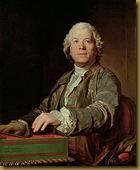
A trio sonata is written for two solo melodic instruments and basso continuo, making three parts in all, hence the name trio sonata. However, because the basso continuo is usually made up of at least two instrumentsGluck, detail of a portrait by Joseph Duplessis, dated 1775 (Kunsthistorisches Museum, Vienna) (typically a cello or bass viol and a keyboard instrument such as the harpsichord), trio sonatas are typically performed by at least four musicians. The trio sonatas by Arcangelo Corelli (opus I, 1681, opus III, 1689) set an inspiring example.
Among the sonatas most directly influenced by Corelli are those of Henry Purcell, who partly modeled his also on those of another Roman, Lelio Colista, Georg Muffat and Georg Frederic Handel. Other composers show strongly divergent tendencies, among them particularly Heinrich Biber and Dietrich Buxtehude. Another group adjusted the Corelli model to the currents of late baroque music, among the most important being Tommaso Albinoni, Antonio Vivaldi, and Francesco Maria Veracini. Their works are characterized by an expansion and roundedness of form, an intensification of fugal writing in the allegros balanced by an increasing homophony in other movements, and many written-out embellishments formerly left to the player.

Several Frenchmen, notably François Couperin and Jean-Marie Leclair , combined the Corelli style with a native flair for simple melody, ever nourished by the air de dance and tastefully laced with trills and turns. The supreme eclectic was Johann Sebastian Bach, who in his manyArcangelo Corelli. sonatas drew together the techniques of an international host of predecessors and contemporaries. In his sonatas and suites for unaccompanied violin and cello, the familiar and aging categories burn with a twilight glow as every difficulty of counterpoint and mechanical limitation of the instruments is pushed aside. Curiously Bach neglected the true trio-sonata, of which the only significant authentic example is that of the Musical Offering for transverse flute, violin, and bass. 


ape, scans

LinkWithin

Related Posts with Thumbnails