Showing posts with label Goebel Reinhard. Show all posts

Monday, October 18, 2010

Johann David Heinichen - Concerti Grandi – Reinhard Goebel, MAK


Review:

Johann David Heinichen (1683 - 1729) Theorist and composer. Keyboard student and assistant of Kuhnau at the Leipzig Thomasschule; enrolled in Leipzig University in 1702, earning a law degree in 1706; began a practice in Weissenfels, where he had contact with Kapellmeister J. P. Krieger and his assistant Grünewald. Moved back to Leipzig in 1709 as opera director, also leading a collegium musicum; journeyed to Italy in 1710, where heDer General Bass enjoyed acclaim as an opera composer in Venice and taught Prince Leopold of Anhalt-Cöthen in Rome. In 1717, while still in Italy, he was appointed Kapellmeister in Dresden, a post he held until his death. Although his output includes a great variety of sacred and secular vocal music and instrumental works, he is best known for his treatise Der Generalbass in der Composition (1728, partially reworked from a publication of 1711), an exhaustive account not only of continuo practice but also of the technical and aesthetic aspects of composition.--Hoasm


ape, covers

Thursday, October 7, 2010

Musica Antiqua Koln, Reinhard Goebel - Chaconne


Review:

This disc was nominated for the 1998 Grammy Award for "Best Small Ensemble Performance."

‘The innocent purpose of this anthology is solely and simply to fill the general listener’s cup with an hour of harmonious pleasure in 3/4 time and to open the door, for the connoisseur, to the 17th-century composer’s workshop.’ This, then, in the words of Reinhard Goebel, director of Musica Antiqua Köln, is the raison d’être of the present disc. Nine consecutive chaconnes may sound a little too much of a good thing, but the wonderfully varied melodic patterns that skilful composers could develop over an ostinato or ground bass fully justify the programme.

Only one of the pieces here, Purcell’s Chacony Z730, will be immediately familiar to listeners other than specialists; for the rest, Goebel has explored some of the byways of the 17th century, omitting the great examples of the late Baroque chaconne by Bach and Rameau in favor of seldom-heard examples by Marini, Mayr, Pezel and others. The Cologne musicians’ carefully prepared menu begins with one of the noblest pieces on the disc, a chaconne with oboes and bassoon from Lully’s opera Phaëton; thereafter the exclusively string textures diminish and swell almost palindromically to reach a climax with a finely sustained chaconne by Georg Muffat. Disciplined and animated playing make the release stimulating and entertaining.-- Nicholas Anderson, BBC Music Magazine

flac,covers

Wednesday, October 6, 2010

Gluck - Trio Sonatas - Musica Antiqua Koln, Goebel


Review:

The trio sonata is a musical form which was particularly popular around the 17th century and the 18th century.

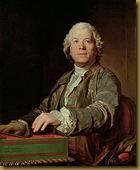
A trio sonata is written for two solo melodic instruments and basso continuo, making three parts in all, hence the name trio sonata. However, because the basso continuo is usually made up of at least two instrumentsGluck, detail of a portrait by Joseph Duplessis, dated 1775 (Kunsthistorisches Museum, Vienna) (typically a cello or bass viol and a keyboard instrument such as the harpsichord), trio sonatas are typically performed by at least four musicians. The trio sonatas by Arcangelo Corelli (opus I, 1681, opus III, 1689) set an inspiring example.
Among the sonatas most directly influenced by Corelli are those of Henry Purcell, who partly modeled his also on those of another Roman, Lelio Colista, Georg Muffat and Georg Frederic Handel. Other composers show strongly divergent tendencies, among them particularly Heinrich Biber and Dietrich Buxtehude. Another group adjusted the Corelli model to the currents of late baroque music, among the most important being Tommaso Albinoni, Antonio Vivaldi, and Francesco Maria Veracini. Their works are characterized by an expansion and roundedness of form, an intensification of fugal writing in the allegros balanced by an increasing homophony in other movements, and many written-out embellishments formerly left to the player.

Several Frenchmen, notably François Couperin and Jean-Marie Leclair , combined the Corelli style with a native flair for simple melody, ever nourished by the air de dance and tastefully laced with trills and turns. The supreme eclectic was Johann Sebastian Bach, who in his manyArcangelo Corelli. sonatas drew together the techniques of an international host of predecessors and contemporaries. In his sonatas and suites for unaccompanied violin and cello, the familiar and aging categories burn with a twilight glow as every difficulty of counterpoint and mechanical limitation of the instruments is pushed aside. Curiously Bach neglected the true trio-sonata, of which the only significant authentic example is that of the Musical Offering for transverse flute, violin, and bass. 


ape, scans

Sunday, September 19, 2010

Sonaten aus Dresden - Goebel, Musiqua Antiqua Koln

Founded in 1973, and disbanded in 2006, Musica Antiqua Köln has been one of the world's outstanding historical performance ensembles of baroque Johann Joseph Fux music. Performances have been marked with intensity, research into older performance styles, and the use of original instruments. MAK produced most recordings on DG Archiv Produktion. They produced award-winning discs of Telemann, Bach, Heinichen, and Bach's family. Reinhard Goebel was the ensemble's director, and first violin. This recording from 1999 features music by Pietro Andrea Ziani, Johann Wilhelm Furchheim, Clemens Thieme and Johann Joseph Fux.

CD INFO

ape,scans

Wednesday, July 28, 2010

Telemann - Wassermusik - 3 Concertos - Goebel, MAK

Click on the cover to download


"Wassermusik" is one of the finest among Telemann's overtures, composed in 1723 to celebrate the centenary of the founding of the Admiralty of Hamburg. The sea with its varying moods is portrayed in the  overture, while dance movements in the suite Goebel-Reinhardare connected with marine mythological figures: Thetis, Neptune, the Naiads, Triton, Aeolus and Zephyr. Telemann displays in this music all his talent for tone painting; his brilliant orchestral colors are splendidly rendered by Goebel and his musicians, who can be heard here in one of their best recordings. Three beautiful concertos, in seven and eight parts, complete this recording.

 
flac, scans


Monday, January 18, 2010

Biber - Rosenkranz Sonaten - Goebel, MAK


Biber - Rosenkranz Sonaten - Goebel, MAK
Chamber | Eac, Ape, cue | log, cover | 2 CD, 530 MB
July 8, 1991 | Archiv | RapidShare


Biber's so-called "Mystery Sonatas" are among the most alluring, meditative, virtuostic and amazingly beautiful compositions ever written for the violin - which this fine recording captures most vividly.

Three aspects of this recording stand out as superb and make this CD a highly recommended recording for Biber's "Mystery Sonatas." The first is the extremely vivid and crystaline sound quality from DG, who created an ideally-resonant sound ambiance that brings out the mystery and depth of this music. Stunning. The second aspect is the most unique, mysterious and musically innovative compositions from the Austrian violin virtuoso and composer, Biber. The depth of emotive effects and degree of virtusosity immediately catch the attention of the listener and draws one into their mysteries (of the life of Christ). In addition to the "standard" harpsichord and/or therebo continuo, these sonatas also add deeply-resonant organ bass pedal-points that create a powerful and alluring backdrop for the drama of the solosit to unfold.

The last aspect that makes this recording special is the accomplished playing of Reinhard Goebels that is of the highest caliber. His technique in the 32nd-note passages is flawless, crisp and worthy of the finest accolades while the sensitive and soaring tonality he exudes in the slower movements is extremely attractive and never grating to the ear. Goebels plays this music not only with the utmost virtuosity but also with a well-judged passion - bringing drama while respecting Biber's sacred and meditative musical intentions by not overly "attacking" the music. His smooth lyricism honors Biber's contemplative designs. So, the combination of these three aspects along with some interesting notes from Goebels on the music and scordatura techniques make this a most desirable and recommended recording from Musica Antiqua Koln. I cannot say there are any "dull moments" or uninspired playing or composing anywhere on the entire 2 CD's - only the most skillfully and mysteriously composed music for violin and Baroque continuo. It remains one of the more unique compositions and an ever-fascinating study of the art of violin playing. And Musica Antique Koln honors this sacred music with the highest art and musical sensitivity.--Amazon


CD Content

Disc: 1
1. I. The Annuciation
2. II. The Visitation
3. III. The Nativity
4. IV. The Presentation
5. V. The Finding in the Temple
6. VI. The Agony in the Garden
7. VII. The Scourging of Jesus
8. VIII. The Crowing of Jesus with Thorns

Disc: 2
1. IX. Jesus carries His Cross
2. X. The Crucifixion
3. XI. The Resurrection
4. XII. The Ascension
5. XIII. The Descent of the Holy Ghost
6. XIV. The Assumption of our Lady
7. XV. The Crowning of the Blessed Virgin Mary
8. Passacaglia


Sunday, December 6, 2009

Concerti 'per l'orchestra di Dresda' - Goebel, Musica Antiqua Koln


Concerti 'per l'orchestra di Dresda' - Goebel, Musica Antiqua Koln
Concerto | Eac, flac, cue | log, cover | 1 CD, 350 MB
January 23, 1996 | Archiv | RapidShare


Truly, I was happy to discover Heinichen, Dieupart, Fasch, Pisendel,Quantz and Veracini. Of course,Vivaldi and Biondi made me discover Pisendel before, but not in this way. For those who did not buy the double Cds of Heinichen (which his highly recommanded by the critics) recorded by Goebel, it's your chance to listen to some of his works. You will enjoy the concerto en fa majeur and the beautiful pastorale. On the whole, all the music recorded here is absolutely sublime. The concertos of Fasch and Quantz are so pleasant to hear that you won't be bored to listen to them again and again. The sonata of Pisendel is, at first, dramatic. But the second movement is brilliant and powerfull. The ouverture of Veracini recorded there is, at my own point of wiew, far more interesting than the Cd dedicated to this composer that Goebel recodered in 1994. This Cd is full of surprises, dynamism and very fast movements. A little tornado...Amazon


CD Content

# Concerto for orchestra in F
Composed by Johann David Heinichen

# Concerto in A minor
Composed by Charles Dieupart

# Concerto in D minor
Composed by Johann Friedrich Fasch

# Sonata da chiesa for strings, 2 oboes & continuo in C minor
Composed by Johann Georg Pisendel

# Pastorale for orchestra in A major, Seibel 242
Composed by Johann David Heinichen

# Concerto for 2 flutes & orchestra in G major
Composed by Johann Joachim Quantz

# Overture No 5 in B flat major
Composed by Francesco Maria Veracini


LinkWithin

Related Posts with Thumbnails